
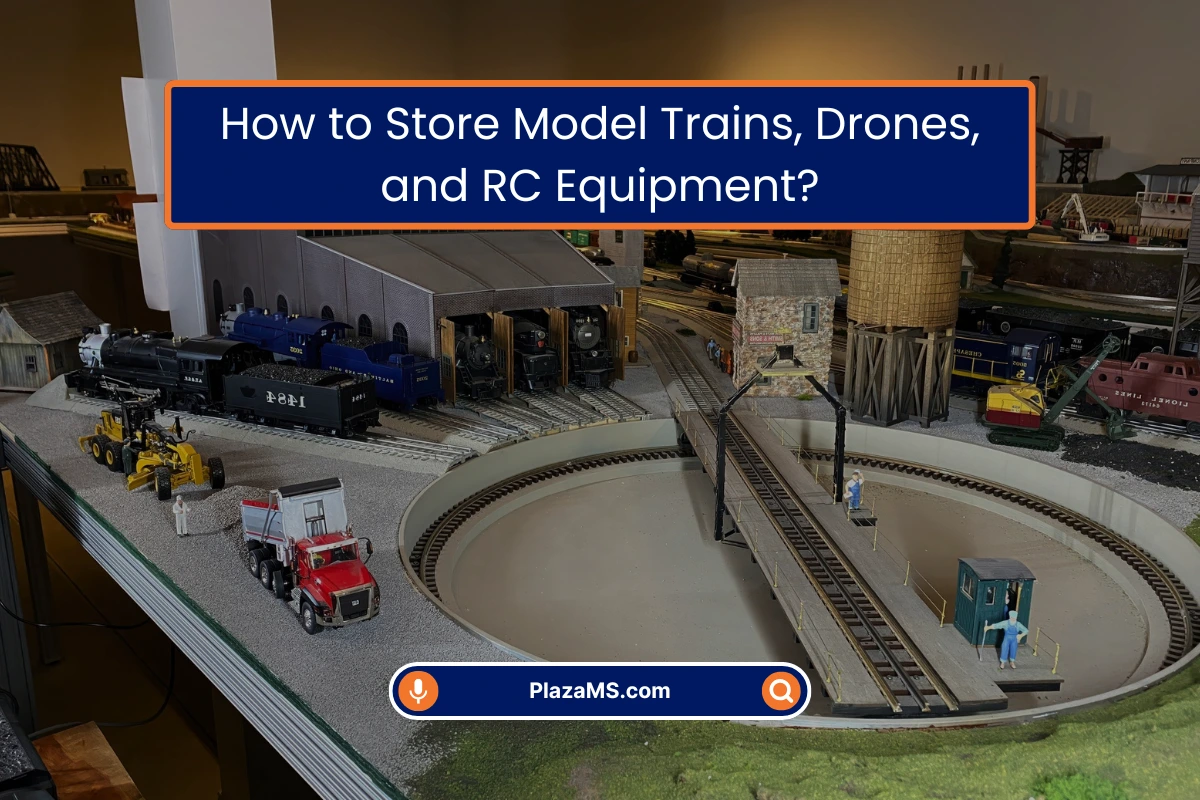
You know how it starts. You buy one little model train set just for fun around the holidays. Or maybe you grab a starter drone to see what all the fuss is about. Fast forward six months, and suddenly your dining room table is a switching yard, your nightstand is a charging station for LiPo batteries, and you’ve got three RC crawlers parked in the hallway like they own the place.
I get it. We really do. Hobbies like model trains, drones, and radio-controlled (RC) gear are amazing for your headspace. They’re fun, they’re creative, and they’re a great way to unplug from the daily grind. But they also come with a ton of stuff. Tracks, controllers, chargers, spare parts, tools, and those delicate little buildings you spent 12 hours painting.
So where do you put it all without turning your living space into a hobby warehouse?
Let’s talk about smart storage for the three biggest space-eaters in the hobby world: model trains, drones, and RC gear. And hey, if you run out of room entirely, we’ve got a local storage unit service that might just save your marriage. But more on that in a minute.
The Model Train Problem: It’s Never Just One Box
If you’re into model trains, you already know this: the train itself is the smallest part of the equation. What really multiplies is everything else.
- Tracks and switches – They bend, they kink, and they hate being thrown into a plastic tote loose.
- Rolling stock – Those little cars are fragile. Couplers snap, wheels bend, and paint scratches if you look at them wrong.
- Scenery and buildings – Trees, crossing gates, tiny people, signal towers. Half of them are made of resin or plaster. One bad drop and you’re re-glueing a chimney for an hour.
- Power supplies and controllers – Wires everywhere. Always.
The biggest mistake we see people make is trying to shove everything into a cardboard box under the bed. That works for about two weeks until you forget which box has the curved tracks versus the straight ones.
Better approach for model trains:
Use shallow, stackable plastic bins. Not the deep ones – shallow. Why? Because deep bins force you to pile things on top of each other. With shallow bins, every layer is visible. Label each bin by type: “Curved Track,” “Straight Track,” “Rolling Stock – Freight,” “Rolling Stock – Passenger.”
For your locomotives and high-value cars, get foam-lined tackle boxes or purpose-made train storage cases. They’re worth the $20 to $30. Trust me, replacing a brass HO scale locomotive is way more expensive than buying a good case.
The Drone Dilemma: Batteries, Blades, and Backpacks
Drones are a whole different beast. You’re not just storing plastic and wires – you’re storing danger if you’re not careful. LiPo batteries need respect.
Most drone hobbyists start with a simple bag. Then they add a second drone. Then a FPV setup. Then a repair kit. Then a field charger. Pretty soon, you’ve got a pile of gear that looks like a tech shop exploded.
Here’s what actually works for drone storage:
- Hard cases with foam inserts are your best friend. Pick-and-pluck foam lets you mold the exact shape of your drone, transmitter, and batteries. This isn’t overkill – it’s protection. One hard landing in the back of your car can snap an arm off a carbon fiber frame if it’s rattling around loose.
- Battery storage is non-negotiable. Never, ever throw loose LiPo batteries in a drawer or a ziploc bag. Use LiPo-safe bags or an actual metal battery box. Store them at storage voltage (around 3.8V per cell) and keep them somewhere cool. We’ve seen too many close calls with puffy batteries.
- Propeller organization – Get a small parts organizer, the kind with adjustable dividers. Props are cheap but annoying to sort through. Keep A props separate from B props, and toss any that have nicks.
One thing we hear a lot: “I’d organize my drone stuff better, but I don’t have a garage or a spare closet.” That’s where a small climate-controlled storage unit changes the game. You don’t need a whole warehouse. Even a 5×5 unit can hold three hard cases, a work table, and a charging station. We offer units exactly that size, and people use them as their personal “hobby HQ.” Just saying.
RC Gear: Trucks, Crawlers, and the Parts That Multiply
RC is the wild west of hobbies. You’ve got everything from tiny 1/24 scale crawlers you can hold in your palm to 1/5 scale monster trucks that barely fit in a car trunk.
The storage challenge with RC is that nothing is uniform. Every truck has different size wheels, different arms, different battery trays. And you’ve got tools – hex drivers, shock pliers, tire glue, camber gauges. It adds up fast.
Practical RC storage tips (that actually work):
- Wall-mounted shelves are underrated: If you can drill into a wall in your garage or basement, put up a few heavy-duty shelves. Park your larger RC vehicles on the bottom shelf, mid-size in the middle, and use the top for parts bins.
- Tire storage – RC tires take up way more space than you think. Hang them on pegboard hooks or stack them inside a large plastic bin with a lid. Keep them away from direct sunlight and ozone (like furnace rooms), or the rubber will dry rot.
- Tool organization – Get a rolling tool chest. Not kidding. The same box a mechanic uses for sockets works perfectly for hex drivers, nut drivers, soldering irons, and shock oils. You can find small 3-drawer units on wheels for under $100 at any hardware store.
The one rule for all three hobbies
Don’t store anything in an attic, a shed without insulation, or a damp basement. Extreme heat kills electronics and warps plastic. Humidity rusts rails and corrodes circuit boards. Cold makes LiPo batteries angry. If your storage spot hits over 85°F or under 40°F regularly, find a better place.
That’s exactly why we keep our storage unit service climate-controlled. You don’t have to worry about your prized HO scale locomotive getting baked in July or your drone batteries freezing in January. It’s just steady, safe, boring temperatures – exactly what delicate hobby gear wants.
When it’s time to call in a storage unit
Look, we love that you have hobbies. We have them too. But there comes a moment for almost every hobbyist when you have to admit: your collection has outgrown your home. That’s not failure. That’s just reality.
Maybe you live in a one-bedroom apartment. Maybe your partner has gently (or not so gently) suggested that the RC crawler on the coffee table isn’t “decor.” Maybe you’re a parent and the kids need that spare bedroom back.
That’s where we come in. Our storage units are clean, secure, and built for exactly this kind of thing – not just boxes of old furniture, but active hobby storage. You can come get your gear whenever you want. Late night? Fine. Early morning before a race? Go for it. We don’t lock you into bankers’ hours.
So go ahead. Buy that new drone. Add that passenger car to your train collection. Grab the RC truck you’ve been eyeing. Just know that when your living room starts looking like a hobby shop, you’ve got a place to put it all.
And if you need a hand figuring out what size unit works for your setup, just ask us. We’ve seen everything from G-scale train layouts to full FPV drone workshops in our units. We’ll get you sorted.
Now go charge those batteries – just do it in a LiPo bag, alright?










0 Comments